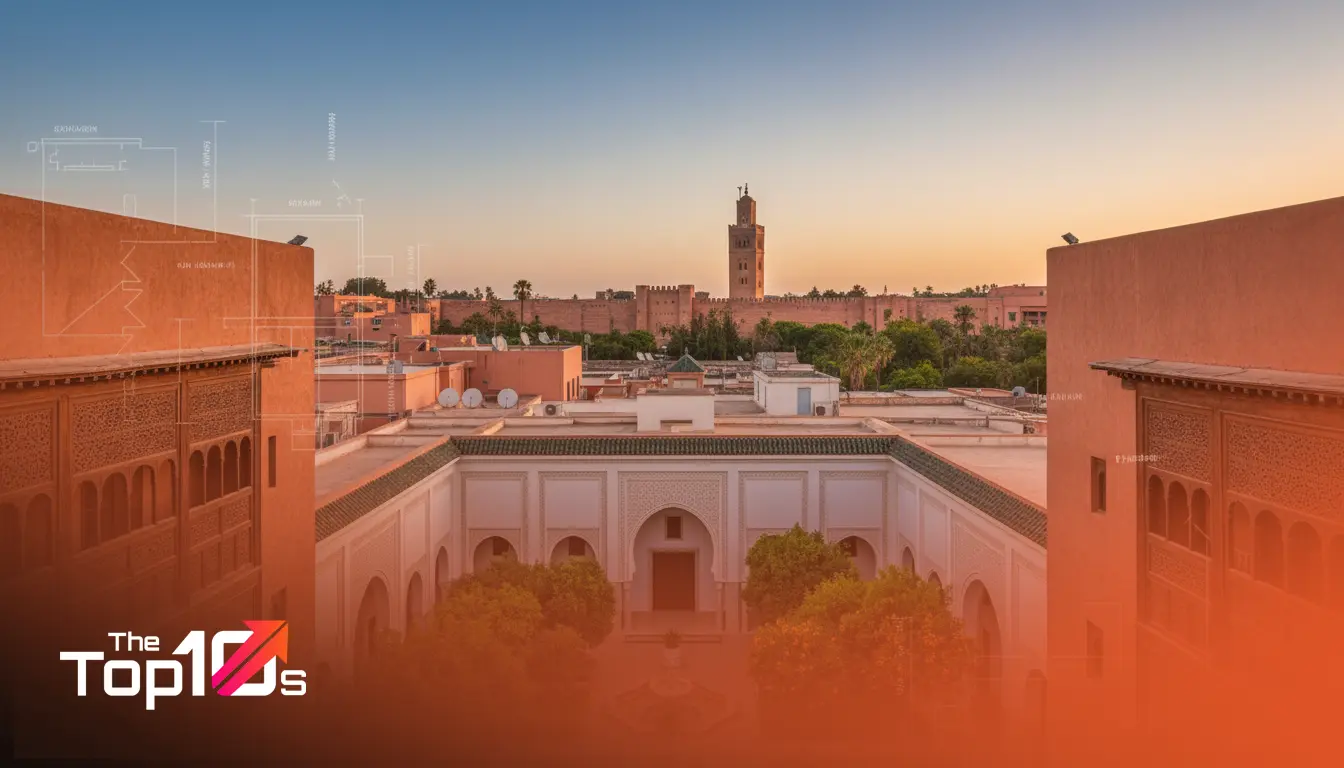
Quick Takeaways: Architectural Planning in Marrakech
- Context is King: The best designs here respect the extreme climate, utilizing thick walls, internal courtyards, and cross-ventilation.
- Regulation Reality: Building in the Medina (old city) involves strict preservation codes compared to the modern districts like Guéliz or Hivernage.
- Material Matters: Look for professionals skilled in Tadelakt (lime plaster), Bejmat, and Pisé (rammed earth) to blend luxury with local identity.
- Timeline Expectations: Administrative approvals can be slow; a seasoned architect acts as your navigator through local bureaucracy.
Walking through the streets of Marrakech offers a masterclass in contrast. You have the dusty, ancient warmth of the Medina rubbing shoulders with the sharp, glass-and-concrete precision of the modern city. For anyone looking to build here, whether it’s a private villa in the Palmeraie or a boutique hotel in Guéliz, the challenge isn’t just about finding someone who can draw a pretty floor plan. It is about finding a partner who understands the soul of the Red City.
Building in Morocco involves a unique set of variables. You are dealing with intense sunlight, specific seismic considerations, and a rich heritage that demands respect even in the most contemporary structures. A brilliant design that ignores the local wind patterns or the angle of the winter sun will eventually become an uncomfortable place to live.
Choosing the right partner for this undertaking is likely the single biggest financial and aesthetic decision you will make during the project. You need a guide who balances artistic vision with technical rigor—someone who knows how to get a permit approved as well as they know how to design a stunning facade.
How We Identified Leading Architects
Selecting the names for this list wasn’t a random exercise. We analyzed the architectural landscape of Marrakech by looking at a specific set of criteria that signals reliability and design excellence. We did not accept payments for placement, nor do we claim to have visited every site personally. Instead, our methodology relies on a deep dive into public portfolios and professional standing.
We looked for consistency in delivery. A firm might have one lucky break, but we prioritized professionals with a sustained track record of completed high-quality projects. We also examined their range of expertise—does the architect understand the nuances of renovating a historic Riad, or are they better suited for large-scale commercial developments?
Furthermore, we considered local integration. The most successful architects in Marrakech are those who collaborate effectively with local artisans (Maâlems). Architecture here often requires a fusion of modern engineering and centuries-old craftsmanship. Finally, we looked for signs of strong regulatory knowledge, favoring firms that demonstrate a clear ability to navigate Morocco’s urban planning laws without compromising the client’s vision.
List of 10 Best Architects in Marrakech
| Name | Best For |
|---|---|
| Studio KO | Clients seeking a world-class, museum-quality aesthetic that blends seamless luxury with raw, tactile materials. |
| Elie Mouyal | Eco-conscious homeowners who want a home that breathes and honors Moroccan heritage deeply. |
| Imaad Rahmouni | Developers and private clients looking for “wow factor” and contemporary luxury suitable for entertaining. |
| Oualalou + Choi | Large-scale developments or institutional projects requiring sophisticated engineering and strong conceptual narratives. |
| Karim El Achak (Cabinet d’Architecture) | Residential and commercial investors looking for a balance of creativity and project security. |
| Atelier Pod (Lotfi Sidirahal) | Hospitality developers needing a cohesive vision from the structural frame down to the furniture design. |
| Amine Kabbaj | Clients wanting a solid, modern home that respects the landscape without looking traditional. |
| Studio KOE (Architecture & Paysage) | Minimalists who view the garden and the house as a single, unified living entity. |
| Abdelhakim Guilmi | Riad renovations and clients who want authentic, historically accurate detailing. |
| Mohamed Amine Siana | Modern urban infill projects and developers looking for striking, contemporary aesthetics. |
Top 10 Architects in Marrakech
The following professionals and firms represent a diverse cross-section of design philosophies, from traditional earth-building purists to avant-garde modernists.
1. Studio KO
Specialization: Cultural Landmarks & Private Luxury Residences
Est. Experience: 20+ Years
While founded by Karl Fournier and Olivier Marty, this firm has become synonymous with the architectural identity of modern Marrakech. They are perhaps best known for the Yves Saint Laurent Museum, a structure that fundamentally changed how the world views contemporary Moroccan architecture. Their work refuses to ignore the environment; instead, it embraces the textures of the earth.
Studio KO is distinct because they avoid the trap of pastiche. They don’t just copy old styles; they reinterpret them using sharp lines and monolithic forms. Their residential projects often feature brickwork and earth tones that allow massive structures to disappear into the landscape.
Best For: Clients seeking a world-class, museum-quality aesthetic that blends seamless luxury with raw, tactile materials.
2. Elie Mouyal
Specialization: Bioclimatic Architecture & Earthen Construction
Est. Experience: 30+ Years
If you are interested in sustainability that goes beyond solar panels, Elie Mouyal is the name you need to know. He is a pioneer in the rehabilitation of earth architecture (pisé and adobe) in Morocco. His philosophy centers on the idea that traditional building methods are not just nostalgic—they are technically superior for the local climate.
Mouyal’s designs regulate temperature naturally, keeping interiors cool in the scorching summer and warm in winter without excessive reliance on HVAC systems. His work possesses a timeless quality, often feeling as though it has stood on the site for centuries while offering modern comforts.
Best For: Eco-conscious homeowners who want a home that breathes and honors Moroccan heritage deeply.
3. Imaad Rahmouni
Specialization: High-End Residential & Hospitality
Est. Experience: 20+ Years
Imaad Rahmouni brings a cosmopolitan flair to the Red City. Having cut his teeth in international markets before returning to Morocco, his style is unabashedly glamorous. He is frequently the architect of choice for luxury restaurants, nightclubs, and expansive villas that serve as entertainment hubs.
His spaces are characterized by dramatic volumes, water features, and a seamless flow between indoors and outdoors. Rahmouni understands the “lifestyle” aspect of architecture—how a space feels during a dinner party or a summer afternoon by the pool.
Best For: Developers and private clients looking for “wow factor” and contemporary luxury suitable for entertaining.
4. Oualalou + Choi
Specialization: Urban Design, Public Buildings & Civil Projects
Est. Experience: 15+ Years
Tarik Oualalou and Linna Choi operate at an intersection where architecture meets urbanism. Their practice is known for intellectual rigor and handling complex public projects, though their residential work is equally compelling. They approach design with a structural boldness that challenges conventional Moroccan forms.
Their projects often feature impressive spans and innovative uses of concrete, resulting in structures that feel monumental. They are excellent at managing large-scale requirements while maintaining artistic integrity.
Best For: Large-scale developments or institutional projects requiring sophisticated engineering and strong conceptual narratives.
5. Karim El Achak (Cabinet d’Architecture)
Specialization: Contemporary Urban Living & Renovations
Est. Experience: 25+ Years
A respected figure in the local architectural community, Karim El Achak has built a reputation for reliability and localized modernism. His firm handles a wide variety of projects, from apartment complexes in the expanding city districts to private homes.
El Achak’s strength lies in his pragmatic approach. He balances the creative desires of the client with the hard realities of construction budgets and zoning laws in Marrakech. His designs often feature clean lines and functional layouts that prioritize livability.
Best For: Residential and commercial investors looking for a balance of creativity and project security.
6. Atelier Pod (Lotfi Sidirahal)
Specialization: Luxury Hospitality & Interior Architecture
Est. Experience: 15+ Years
Lotfi Sidirahal’s Atelier Pod is where architecture meets high-end brand identity. Although they operate internationally, their impact on the Moroccan hospitality scene is significant. They don’t just build shells; they design immersive experiences.
Their work often blurs the line between architecture and interior design. Every corner, lighting fixture, and material transition is calculated to evoke a specific mood. If you are developing a boutique hotel or a resort, their understanding of guest psychology is invaluable.
Best For: Hospitality developers needing a cohesive vision from the structural frame down to the furniture design.
7. Amine Kabbaj
Specialization: Modern Moroccan Villas & Commercial Spaces
Est. Experience: 20+ Years
Amine Kabbaj is known for a style that feels robust and grounded. He frequently uses local stone and traditional coloring but applies them to very modern, geometric forms. His architecture communicates a sense of permanence and stability.
He is particularly skilled at site integration, ensuring that a building sits naturally within its topography rather than dominating it. His portfolio includes several striking private residences that maximize views of the Atlas Mountains.
Best For: Clients wanting a solid, modern home that respects the landscape without looking traditional.
8. Studio KOE (Architecture & Paysage)
Specialization: Landscape Integration & Minimalist Design
Est. Experience: 10+ Years
Not to be confused with Studio KO, this firm (often associated with architects like Richard Lampert) places a massive emphasis on the relationship between the garden and the house. In Marrakech, where the garden is essentially an outdoor living room, this expertise is crucial.
Their designs are often minimalist, using white cubes and sharp angles to contrast with the organic chaos of the surrounding vegetation. They prioritize light and shadow play, creating spaces that change character throughout the day.
Best For: Minimalists who view the garden and the house as a single, unified living entity.
9. Abdelhakim Guilmi
Specialization: Heritage Preservation & Neo-Traditional Design
Est. Experience: 25+ Years
For those who love the intricacies of the Medina, Abdelhakim Guilmi represents a deep connection to history. His work often involves the restoration of Riads or the construction of new buildings that strictly adhere to traditional proportions and detailing.
He is a master of the courtyard. Guilmi understands how to create that specific sense of tranquility that defines Moroccan domestic architecture, shutting out the noise of the city to create an internal sanctuary.
Best For: Riad renovations and clients who want authentic, historically accurate detailing.
10. Mohamed Amine Siana
Specialization: Urban Housing & Educational Facilities
Est. Experience: 15+ Years
A younger voice bringing fresh energy to the scene, Mohamed Amine Siana is gaining recognition for striking, sculptural concrete work. He often experiments with the building skin, creating facades that filter light in interesting ways—a modern take on the traditional Mashrabiya.
His approach is highly geometric and often surprisingly affordable given the visual impact. He proves that good design isn’t just for billionaires; it can also elevate apartment blocks and schools.
Best For: Modern urban infill projects and developers looking for striking, contemporary aesthetics.
What Defines a Great Architect in Marrakech?
Architecture in this region is about more than just aesthetics; it is an exercise in climate management. A talented architect here understands thermal inertia. The sun in Marrakech can be unforgiving, and the temperature drops significantly at night. The best professionals design walls that absorb heat during the day and release it at night, naturally regulating the indoor environment.
Furthermore, an excellent Marrakech architect must be a diplomat. The bureaucratic landscape regarding permits, especially near historical sites, is complex. If your project extends beyond the Red City or you are comparing styles across the region, looking at the top 10 architects in Casablanca can provide a broader perspective on Moroccan modernism, but keep in mind that Marrakech has distinct zoning laws that favor low-rise, terracotta-colored structures.
Finally, they must possess a network of skilled artisans. Modern construction is easy; finding a Maâlem who can execute perfect Zellige tiling or intricate cedar wood carving is an art form. The architect acts as the bridge between these ancient crafts and your modern expectations.
How to Choose the Right Architect for Your Needs
Finding the right fit involves asking the tough questions before you sign a contract. Do not just look at the photos of their finished work; ask about the process.
Evaluate their communication style. Many projects in Marrakech face delays due to supply chain issues or labor shortages. You want an architect who communicates bad news as clearly as good news. If they promise a friction-less process, be skeptical.
Check their specific experience with your property type. A firm that excels at concrete apartment blocks in Guéliz might struggle with the fragile mud-brick renovation of a Riad in the Medina. These are two different disciplines requiring different structural engineers and contractors.
Ask about their site supervision (Suivi de Chantier). In Morocco, the architect’s role during construction is critical. If they only provide the drawings and rarely visit the site, quality control will suffer. Ensure your contract includes regular site visits.
Frequently Asked Questions
Do I need a local architect to build in Marrakech?
Yes, legally you must have an architect registered with the Ordre National des Architectes du Maroc to obtain a building permit for most construction projects. Even if you hire an international designer, they will need to partner with a local architect of record to sign off on the plans and handle the permitting.
How much do architects charge in Marrakech?
Fees vary wildly based on reputation and scope, but generally, you can expect to pay between 5% and 10% of the total construction cost for full architectural services (design plus site supervision). High-profile firms may charge a fixed design fee that is significantly higher.
What is the difference between a Riad and a Villa?
A Riad is a traditional inward-facing home centered around a courtyard/garden, typically found in the Medina. A Villa is an outward-facing detached house with a surrounding garden, usually found in the newer districts or the Palmeraie.
Can I build a modern glass house in Marrakech?
It depends on the zone. In the Palmeraie and certain rural zones, you have more creative freedom, though you may still be required to use earth-toned exterior finishes. In the Medina, strict preservation codes generally prohibit glass facades to maintain the historic character.
How long does it take to get a building permit?
Timelines are unpredictable. Simple projects might get approved in 2-3 months, while complex developments or those in sensitive heritage zones can take 6 months or longer. An experienced architect can often expedite this by knowing exactly what the urban agency requires.
Moving Forward with Your Vision
Building in Marrakech is an adventure. It is an opportunity to create something that captures the magic of North African light and the warmth of Moroccan hospitality. However, the gap between a dream project and a construction nightmare is almost always defined by the quality of your team.
Take the time to meet with multiple firms. Visit their completed sites, not just their offices. Touch the walls, stand in the courtyards, and listen to the acoustics. When you find an architect who understands not just what you want to build, but how you want to live, you will know you have found the right partner.