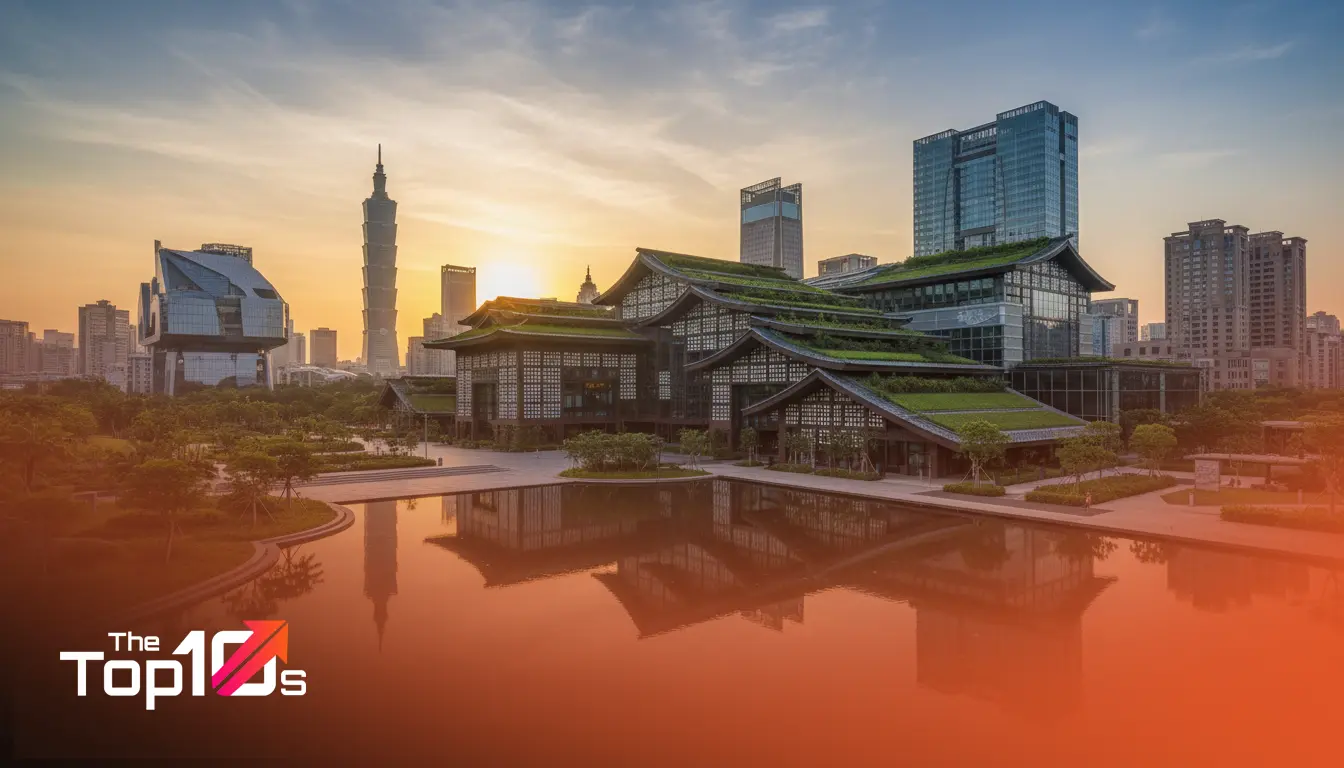
Building in Taiwan presents a unique set of challenges that would make even seasoned developers pause. You are dealing with a subtropical climate that demands heavy cooling, a geographical location prone to seismic activity, and some of the highest urban density rates in the world. Yet, walking through districts like Xinyi in Taipei or the artistic corners of Taichung, you see breathtaking structures that seem to defy these constraints.
Choosing the right design partner here isn’t just about aesthetics; it is about finding someone who understands how to marry structural safety with cultural nuance. Whether you are planning a boutique hotel in Tainan, a corporate HQ in Hsinchu, or a family residence in New Taipei City, the difference between a stalled project and an award-winning landmark often comes down to the lead architect.
You might be wondering where to start your search in a market flooded with firms ranging from massive international conglomerates to local boutique studios. We have curated a list of professionals who are currently shaping the skyline and redefining living spaces across the island.
- Context is King: Look for professionals who specialize in Taiwan’s specific climate (high humidity and typhoons).
- Regulatory Navigation: Local building codes are strict; ensure your choice has a track record of smooth permit approvals.
- Scale Matters: The firm designing high-speed rail stations may not be the best fit for a private luxury villa.
- Communication: If you are an international investor, bilingual capabilities (Mandarin/English) are non-negotiable.
How We Identified Leading Architects
Determining the “top” professionals in a subjective field like design requires looking beyond flashy website renders. We approached this selection process by analyzing the substance behind the portfolio. Our focus wasn’t just on who wins the most awards, but who consistently delivers viable, enduring structures.
We examined the depth of architectural experience, specifically looking for firms that have weathered Taiwan’s economic shifts and construction booms. We also considered the diversity of their work. A strong practice usually demonstrates capability across different typologies, from public infrastructure to intimate private spaces.
Reputation within the local construction industry played a massive role in our assessment. We looked for signals of reliability—how well do they collaborate with engineers? Do they respect the local environment? We also factored in the firm’s philosophy regarding sustainability, which is becoming increasingly critical in Taiwanese urban planning. The names below represent a mix of established veterans and innovative studios that are pushing boundaries.
Top 10 Architects In Taiwan
1. Kris Yao (KRIS YAO | ARTECH)
If you have traveled through Taiwan, you have likely walked through or stared at a building designed by Kris Yao. His firm, ARTECH, is arguably the most internationally recognized practice on the island. Yao is known for “Poetic Rationalism,” a style that manages to be incredibly efficient and modern while retaining a distinct sense of Eastern spirituality and calm.
Notable Strengths:Yao excels at large-scale civic and commercial projects. His work often integrates glass and steel with local cultural motifs. The Lanyang Museum in Yilan, which mimics the cuestas (sloped ridges) of the coastline, is a prime example of his site-specific genius.
Best Suited For:Corporations, government bodies, or institutions looking for landmark architecture that commands global attention.
2. Joshua Jih Pan (J.J. Pan and Partners)
With a career spanning decades, Joshua Jih Pan is a pillar of the Taiwanese architectural community. His firm is synonymous with technical excellence and rigorous planning. What stands out about Pan’s approach is his early and consistent dedication to sustainability before it was a buzzword.
Notable Strengths:The firm is heavily involved in high-tech industrial facilities and advanced research centers, particularly in the Hsinchu Science Park area. They understand the complex mechanical and electrical requirements of sophisticated buildings while maintaining aesthetic discipline.
Best Suited For:Tech companies, educational institutions, and healthcare providers requiring complex, high-performance facilities.
3. Huang Sheng-Yuan (Fieldoffice Architects)
Huang Sheng-Yuan represents the soul of localized Taiwanese architecture. Based in Yilan County, he famously refuses to take projects that are too far from his office, believing that an architect must visit the site daily to truly understand it. His work is organic, often blurring the lines between landscape, urbanism, and structure.
Notable Strengths:He creates spaces that feel like they grew out of the earth. His designs often utilize raw concrete, brick, and steel in ways that embrace the weathering process of Taiwan’s humid climate rather than fighting it.
Best Suited For:Public sector cultural projects, parks, and community centers that require deep integration with the surrounding landscape.
4. Bio-architecture Formosana
Founded by Ying-Chao Kuo and Chang-Hwa Chang, this firm is at the forefront of the green building movement in Taiwan. Their philosophy centers on the coexistence of humans and nature, addressing the island’s energy challenges head-on.
Notable Strengths:They are masters of passive design—using building orientation, ventilation, and shading to reduce energy consumption. Their Beitou Branch of the Taipei Public Library is an iconic example of timber construction in a humid environment, achieving the Diamond Level of the EEWH green building certification.
Best Suited For:Environmentally conscious developers and public organizations aiming for high sustainability certifications.
5. Grace Cheung (XRANGE)
For something edgier and more urban, Grace Cheung’s XRANGE offers a fresh perspective. As the first true design-focused firm in Taiwan to blend architecture with landscape and master planning, XRANGE tackles the chaotic beauty of Taipei’s density with bold, unexpected forms.
Notable Strengths:Cheung isn’t afraid of unconventional materials or shapes. Her work often challenges standard typologies, creating buildings that stand out as art pieces. She brings a cosmopolitan, cross-disciplinary approach that appeals to modern tastes.
Best Suited For:Boutique developers, luxury residential clients, and commercial brands looking for a distinct, avant-garde identity.
6. MAYU Architects
Based in Tainan, the historical capital, Malone Chang and Yu-lin Chen lead a practice that balances academic rigor with practical execution. Their work often reflects the slower, more culturally dense atmosphere of southern Taiwan while utilizing sharp, contemporary geometry.
Notable Strengths:They have a knack for educational and public buildings that encourage social interaction. Their designs often feature large, welcoming atriums and circulation paths that act as public squares.
Best Suited For:Libraries, schools, and civic centers where community engagement is the primary goal.
7. Wenyuan Peng (Yuan Architects)
Wenyuan Peng has carved out a reputation for elegance and minimalism. His work often explores the concept of “fluidity,” creating spaces where the interior and exterior seem to merge. There is a quiet luxury to his portfolio that speaks to high-end living.
Notable Strengths:Peng is particularly skilled at residential architecture that maximizes light and space in tight urban lots. His use of white palettes and clean lines creates a sense of serenity amidst the city noise.
Best Suited For:Private homeowners and luxury residential developers seeking a modern, gallery-like aesthetic.
8. B+P Architects
This firm creates interesting narratives within their spaces. They are known for adaptive reuse—taking old, sometimes dilapidated Taiwanese structures and breathing new life into them without erasing their history.
Notable Strengths:Their ability to work with existing textures—old tiles, worn concrete—and layer modern functionality on top is impressive. They understand the “vernacular” of Taiwanese alleyways and shophouses better than most.
Best Suited For:Renovation projects, cultural hubs, and commercial spaces situated in historical districts.
9. Q-LAB
If you are looking for parametric design and high-tech aesthetics, Q-LAB is the firm to watch. They utilize advanced digital modeling to create complex geometries and efficient structural systems. Their work often looks futuristic, pushing the envelope of what local construction teams can achieve.
Notable Strengths:They are highly data-driven. Their design process involves rigorous analysis of budget, schedule, and spatial programming, resulting in buildings that are as logical as they are visually striking. Their sports centers are particularly well-regarded.
Best Suited For:Municipal sports facilities, transport hubs, and commercial complexes requiring a modern, dynamic look.
10. Waterfrom Design
While often categorized as interior designers, Waterfrom Design blurs the boundary between architecture and interior spatial planning. Their work is incredibly narrative-driven, often treating a space as a story to be walked through.
Notable Strengths:They excel at “human scale” projects. Their material palettes are often warm, tactile, and playful. They bring a level of detail to the interior architecture that large structural firms sometimes overlook.
Best Suited For:High-end retail, hospitality (restaurants/cafes), and private residences where the interior atmosphere is paramount.
What Defines a Great Architect in Taiwan?
Architecture in Taiwan operates in a context that is distinct from Europe or North America. A great architect here must be a master of resilience. They aren’t just designing for gravity; they are designing for lateral forces from earthquakes and wind loads from super-typhoons. This technical reality influences every aesthetic decision, from the thickness of the columns to the choice of façade materials.
Furthermore, the best professionals understand the local culture of “mixed-use” living. In Taiwanese cities, commercial and residential zones often overlap. A skilled designer knows how to create privacy for a third-floor apartment while maintaining an inviting storefront on the ground level. They also respect the concept of Feng Shui, which, regardless of your personal belief, plays a massive role in the resale value and marketability of a property in this region.
Finally, material knowledge is crucial. The high humidity levels mean that certain woods or untreated metals will deteriorate rapidly. Top-tier architects know which local stones, tiles, and concrete mixes will age gracefully rather than rot or stain.
How to Choose the Right Architect for Your Needs
Finding the right partner is about aligning their expertise with your specific constraints. Here is a framework to guide your decision.
Assess the Portfolio for “Built” Reality
Renderings are easy; construction is hard. Look closely at photos of completed projects that are at least three to five years old. How is the building aging? Does the reality match the initial concept? This is particularly important in Taiwan’s harsh climate.
Check Regional Connectivity
If you are building in the south (Kaohsiung or Tainan), hiring a Taipei-based firm that rarely travels south might lead to supervision issues. Local relationships with contractors and government officials can speed up permitting processes significantly. Similarly, if your project scope expands across the broader Asian market, you might want to look at how firms in other hubs operate. For example, comparing the top 10 architects in Singapore with Taiwanese firms can give you a benchmark for tropical urban design standards.
Interview for Communication Style
Construction is a long, stressful marriage. You need a partner who communicates clearly. Ask potential candidates how they handle budget overruns or unexpected site conditions. Their answer should be practical and process-oriented, not vague.
Understand the Fee Structure
Architectural fees in Taiwan can vary wildly. Some charge a percentage of construction cost, while others work on a fixed fee. Ensure you understand what is included—does this cover interior design? Landscape? Submission for government permits? Clarity here prevents disputes later.
Frequently Asked Questions
Do I need a local architect if I already have an international design?
Yes. Even if you have a design from a famous overseas firm, you legally require a locally licensed architect in Taiwan to sign off on the plans and submit them for building permits. They act as the Architect of Record and ensure the design meets local codes.
How much do architects charge in Taiwan?
Fees typically range from 3% to 10% of the total construction cost, depending on the complexity of the project and the fame of the firm. Renovation projects often command higher percentage fees due to the unpredictability of existing structures.
Are sustainable “Green Buildings” mandatory in Taiwan?
For certain scales of public projects and large developments, yes. Taiwan uses the EEWH certification system (similar to LEED). Even for private homes, adhering to these standards can save significantly on electricity bills for air conditioning.
Can architects in Taiwan help with finding contractors?
Absolutely. Experienced architects have a network of trusted general contractors and subcontractors. Using their recommendations can lower the risk of hiring unreliable labor, which is a common issue in the industry.
What is the biggest challenge when building in Taipei?
Space and zoning. Taipei is incredibly dense, and zoning laws regarding “setbacks” (how far you must build from the street) and Floor Area Ratios (FAR) are strictly enforced. You need an architect who is an expert in maximizing usable space within these legal limits.
Conclusion
Selecting an architect in Taiwan is a decision that shapes not just a physical structure, but the financial and functional future of your investment. The professionals listed above represent the best of the industry—ranging from visionaries who shape national museums to detailed craftsmen who transform private homes.
Don’t rush the selection process. Take the time to visit their completed sites. Stand in the lobby, touch the walls, and see how the space makes you feel. A great portfolio gets them the interview, but their ability to listen and translate your needs into a safe, compliant, and beautiful reality is what should get them the job.